Operation
Most IR thermometers operate according to the same basic operating principles (Figure 1).
A bandwidth ilter and optical lens are used to focus the IR energy emitted by an object onto a detector, which converts the IR radiation into an electrical signal. After compensating for emissivity (see below) and ambient temperature, an analog output is generated to provide temperature measurement. The analog signal can be converted to digital when fast acquisition rates are required.
Emissivity
The emission of thermal radiation is a surface phenomenon for most materials. The term emissivity refers to an object’s ability to emit thermal radiation.
Emissivity is defined as the ratio between the energy emitted by an object at a given temperature and a perfect radiator, or blackbody, at the same temperature. Emissivity values lie between zero and one. IR thermometers generally have the ability to compensate for the different emissivity values of materials.
Materials with the highest emissivity values are the easiest to measure accurately with IR thermometers, while those with low emissivities are more difficult. For example, some polished, shiny metallic surfaces, such as aluminum, are so reflective in the infrared that accurate temperature measurement is not always possible.

Tables listing emissivity values for various materials have been published, and are available for reference (Table). Some IR thermometers allow users to change emissivity values according to the material being measured, while others have a pre-set emissivity value.
When using IR thermometry, it is important to consider that materials can have different emissivity values at different wavelengths. To determine an emissivity value, you can heat a material to a known temperature, then adjust the emissivity value of the instrument until the IR thermometer matches the known temperature.
Field of view (FOV)
The FOV is the angle of vision at which the instrument operates and is determined by the optics of the system. The optical system of the IR thermometer collects the IR energy from a circular measurement spot, and focuses the energy on the detector. The optical resolution of the instrument is determined by the ratio between the distance from instrument to object and the size of the spot being measured (distance-to-spot ratio). Higher ratios mean better resolution.
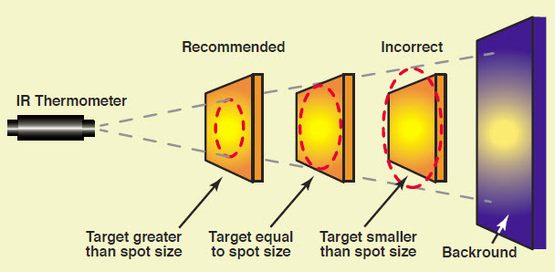
Ideally, the target being measured should fill the instrument’s FOV. For the best performance, the target object area should exceed the FOV by a factor of about 1.5 (Figure 2).
Calibration
IR thermometers can be calibrated by aiming at blackbody radiators that are designed specifically for calibration and testing. By varying the source temperature of the blackbody, calibrators can tune the IR sensor’s internal measurement signal to known temperatures.
Selection questions to consider
When selecting an IR thermometer for a CPI application, it is important to consider the following questions:
- What is the required proximity to the target?
- What is the size of object to be measured, and will it it the instrument’s FOV?
- Are there any physical obstructions between the object to be measured and the measuring device
- Are smoke, dust or other particulate matter likely to be in the measurement area?
- What are the measurement control frequency requirements?
- Does the object have a shiny surface?
- What are the output/interface requirements?
References
1. Young, A., IR Thermometry Finds CPI Niches, Chem. Eng., Feb. 2002, pp. 56–60.
2. Omega Engineering Inc. [Internet]. c2003–2010. Stamford (CT). [cited Feb. 2011]. Available from: http://www.omega.com/.