
Bienvenidos en chino
Mobbing-acoso laboral-IRG
Mostrando entradas con la etiqueta Cerebro. Mostrar todas las entradas

Specialized astrocytes mediate glutamatergic gliotransmission in the CNS


Multimodal astrocyte–neuron communications govern brain circuitry assembly and function1. For example, through rapid glutamate release, astrocytes can control excitability, plasticity and synchronous activity2,3 of synaptic networks, while also contributing to their dysregulation in neuropsychiatric conditions4,5,6,7. For astrocytes to communicate through fast focal glutamate release, they should possess an apparatus for Ca2+-dependent exocytosis similar to neurons8,9,10. However, the existence of this mechanism has been questioned11,12,13 owing to inconsistent data14,15,16,17 and a lack of direct supporting evidence. Here we revisited the astrocyte glutamate exocytosis hypothesis by considering the emerging molecular heterogeneity of astrocytes18,19,20,21 and using molecular, bioinformatic and imaging approaches, together with cell-specific genetic tools that interfere with glutamate exocytosis in vivo. By analysing existing single-cell RNA-sequencing databases and our patch-seq data, we identified nine molecularly distinct clusters of hippocampal astrocytes, among which we found a notable subpopulation that selectively expressed synaptic-like glutamate-release machinery and localized to discrete hippocampal sites. Using GluSnFR-based glutamate imaging22 in situ and in vivo, we identified a corresponding astrocyte subgroup that responds reliably to astrocyte-selective stimulations with subsecond glutamate release events at spatially precise hotspots, which were suppressed by astrocyte-targeted deletion of vesicular glutamate transporter 1 (VGLUT1). Furthermore, deletion of this transporter or its isoform VGLUT2 revealed specific contributions of glutamatergic astrocytes in cortico-hippocampal and nigrostriatal circuits during normal behaviour and pathological processes. By uncovering this atypical subpopulation of specialized astrocytes in the adult brain, we provide insights into the complex roles of astrocytes in central nervous system (CNS) physiology and diseases, and identify a potential therapeutic target.

Ver mas...

Conocer el cerebro para vivir mejor Facundo Manes, neurocientífico


En Estados Unidos, el 40% de la sociedad se siente sola de forma crónica en algún momento de la vida. Inglaterra acaba de crear un Ministerio de la Soledad... No porque sean amantes de la neurociencia los del gobierno inglés, sino porque saben, tienen datos, tienen evidencia científica de que la soledad es muy frecuente y que produce problemas de salud que tienen un costo enorme para la sociedad".

En este vídeo, el neurocientífico Facundo Manes explica las claves para mantener en forma al cerebro, cómo surge la creatividad, el "momento eureka" y cómo aprendemos y olvidamos.

Facundo Manes ha dedicado gran parte de su trayectoria profesional a descifrar los secretos del cerebro, actividad que sigue desarrollando como investigador del Consejo Nacional de Investigaciones Científicas y Técnicas (CONICET) de Argentina y del departamento Cognition and Brain Sciences de Cambridge.

A mis hijos les digo: "Estudiá, porque además de que te va a permitir ser más libre y tener más oportunidades, cumplir tus sueños, levantar la autoestima, adaptarte a un mundo en permanente cambio... además de todo eso, va a proteger tu cerebro”, reflexiona el neurocientífico.

Fundador del Instituto de Neurología Congnitiva (INECO) y del Instituto de Neurociencias de la Fundación Favaloro en Buenos Aires, el doctor Manes es autor de libros como ‘El cerebro del futuro’ y ‘Usar el cerebro’, donde explica el funcionamiento de nuestra materia gris.

Fuente: AprendemosJuntos

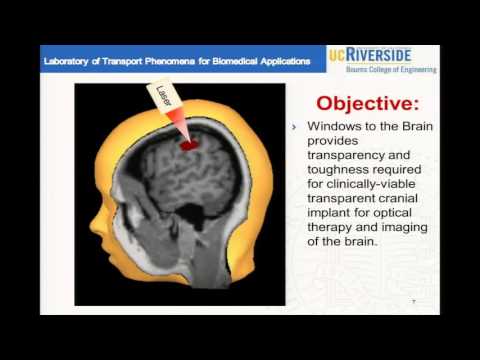
Windows to the Brain CITRIS

Clic en la imagen

Guillermo Aguilar joined the Department of Mechanical Engineering at University of California Riverside, where he was promoted to Associate Professor in 2007, Full Professor in 2012 and since 2013 serves as the Department Chair. His current research interests include cryogen spray cooling, laser-tissue interactions, biomedical optics and medical lasers.

Abstract:

One of the recent research thrusts in my research group aims at developing a novel transparent cranial implant (“window”) that enables life-long, non-invasive delivery and/or collection of laser light into and from shallow and deep brain tissue on demand. Such an implant would allow for real-time and highly precise visualization and treatment of diverse brain pathologies, such as those resulting from traumatic brain injury or brain tumors, without the need of highly-invasive craniotomies or trepanation procedures. The window could be permanently covered with native scalp that can be rendered temporarily transparent on demand in a minimally-invasive manner.

In collaboration with other research groups at UCR, an YSZ implant has been successfully fabricated with current-activated powder-assisted densification (CAPAD) processing method. A summary of these results as well as ongoing and future studies pertaining to this research thrust will be presented.

Fuente: Citris