





Mostrando entradas con la etiqueta Thermodynamics. Mostrar todas las entradas
Mostrando entradas con la etiqueta Thermodynamics. Mostrar todas las entradas






Efecto de la Presión sobre la Capacidad Calorífica Diseño de Plantas Químicas
MSc. Luis Moncada Albitres

Los datos de las capacidades caloríficas dados en los “handbooks”, son usualmente para el estado del gas ideal. La ecuación correspondiente debería escribirse como:
Cpo = a + b T + c T2 + d T3
donde el supercero se refiere al estado de gas ideal.
Los valores para el comportamiento ideal, pueden usarse para el comportamiento real a bajas presiones. A presiones altas, el efecto de la presión sobre el calor específico puede ser muy apreciable.
Edmister (1948) publicó una correlación generalizada mostrando la corrección debido a la presión a condiciones isotérmicas para gases reales como función de la presión reducida y la temperatura y se conoce como la carta de Edmister’s (Sterbacek et al. 1979), la cual está basada en hidrocarburos, pero que puede usarse para otros materiales para dar una indicación del probable error si se usan valores de calores específicos de gases ideales sin corregirlos.
El método es ilustrado en el siguient ejemplo.
Edmister (1948) publicó una correlación generalizada mostrando la corrección debido a la presión a condiciones isotérmicas para gases reales como función de la presión reducida y la temperatura y se conoce como la carta de Edmister’s (Sterbacek et al. 1979), la cual está basada en hidrocarburos, pero que puede usarse para otros materiales para dar una indicación del probable error si se usan valores de calores específicos de gases ideales sin corregirlos.
El método es ilustrado en el siguient ejemplo.
Ejemplo
La capacidad calorífica del etileno para el estado ideal está dada por la ecuación:
Cp = 3,95 + 15,6 x 10⁻² T – 8,3 x 10⁻⁵ T2 + 17,6 x 10⁻⁹ T3 J/mol K
Estimar el valor a 10 bar y 300 K.
Solución
Etileno: presión crítica 50,5 bar
Temperatura crítica 283 K
Cp = 3,95 + 15,6 x 10-2 x 300 – 8,3 x 10-5 x 3002 + 17,6 x 10-9 x 3003
= 43,76 J/mol K
Pr = 10/50,5 = 0,20
Tr = 300/283 = 1,06
De la carta de Edmister’s, Cp – Cp° ≈ 4 J/mol K
Así,
Cp = 43,76 + 4 = 47,76 J/mol K
Ver también: 1 | 2 | 3 | 5 | 6 | 7

Thermodynamics A Core Text
by C. Srivastava, K. Saha and K. Jain

Table of Contents
1. The Nature and Scope of Thermodynamics
2. Important Terminologies in Thermodynamics
3. The First Law of Thermodynamics
4. Defining Thermodynamics State: The State Postulate
5. The Second Law of Thermodynamics
6. The Question of Ideality
7. Statistical Thermodynamics
8. Non-equilibrium Thermodynamics
9. The Non-linear Region
10. Network Thermodynamics
11. Causality Principle in Non-equilibrium Thermodynamics
Termodinámica 6ed por Yunus A. Cengel y Michael A. Boles

Tabla de Contenidos
Capítulo 1
Introducción y Conceptos Básicos
Capítulo 2
Energía, Transferencia de Energía y Análisis de la Energía
Capítulo 3
Propiedades de las Sustancias Puras
Capítulo 4
Análisis de Energía de Sistemas Cerrados
Capítulo 5
Análisis de Masa y Energía de Volúmenes de Control (Sistemas Abiertos)
Capítulo 6
La Segunda Ley de la Termodinámica
Capítulo 7
Entropía
Capítulo 8
Exergía: Una medida del Potencial de Trabajo
Capítulo 9
Ciclos de Potencial de Gas
Capítulo 10
Ciclos de Potencia de Vapor y Combinados
Capítulo 11
Ciclos de Refrigeración
Capítulo 12
Relaciones de Propiedades Termodinámicas
Capítulo 13
Mezclas de Gases
Capítulo 14
Mezclas de Gas-Vapor y Acondicionamiento de Aire
Capítulo 15
Reacciones Químicas
Capítulo 16
Equilibrio Químico y de Fase
Capítulo 17
Fluido Compresible
Apéndice 1
Tablas de Propiedades, Figuras y Diagramas (Unidades SI)
Apéndice 2
Tablas de Propiedades, Figuras y Diagramas (Unidades Inglesas)
Handbook of Phase Change Boiling and Condensation
by Satish G. Kandlikar and Masahiro Shoji and Vijay K. Dhir

CONTENTS
1 VAPOR LIQUID EQUILIBRIUM PROPERTIES
2 REPRESENTATION OF SOLID-LIQUID-VAPOR PHASE INTERACTIONS
3 BOILING CURVE
4 NUCLEATE BOILING
5 ENHANCEMENT TECHNIQUES IN POOL BOILING
6 CRITICAL HEAT FLUX IN POOL BOILING
7 FILM AND TRANSITION BOILING
8 INTRODUCTION AND BASIC MODELS
9 FLUID MECHANICS ASPECTS OF TWO-PHASE FLOW
10 TWO-PHASE FLOW INSTABILITIES
11 CRITICAL TWO PHASE FLOW
12 TWO-PHASE FLOW AND BOILING HEAT TRANSFER IN TUBE BUNDLES
13 EXTERNAL FLOW FILM BOILING
14 AUGMENTATION TECHNIQUES AND EXTERNAL FLOW BOILING
15 FLOW BOILING IN CIRC ULAR TUBES
16 FLOW BOILING IN ADVANCED GEOMETRIES AND APPLICATIONS
17 CHF AND POST-CHF (POST-DRYOUT) HEAT TRANSFER
18 FLOW BOILING AUGMENTATION
19 FILM CONDENSATION
20 DROPWIS E CONDENSATION
21 DIRECT CONTACT CONDENSATION
22 AUGMENTATION TECHNIQUES IN EXTERNAL CONDENSATION
23 HEAT TRANSFER AND PRESSURE DRO P IN INTERNAL FLOW CO NDENSATIO N
24 AUGMENTATION TECHNIQUES AND CONDENSATION INSIDE ADVANCED GEOMETRIES
25 INSTRUMENTATION IN BOILING AND CONDENSATION STUDIES
Total Heat Recovery Heat and Moisture Recovery from Ventilation Air
by Li-Zhi Zhang

Table of Contents
Chapter 1 Total Heat Recovery in Air-conditioning
Chapter 2 Energy Recovery Potentials
Chapter 3 Estimation of Sorption and Diffusion Properties of Hygroscopic Materials
Chapter 4 Performance of Energy Wheels
Chapter 5 Heat Mass Transfer in Bended Sinusoidal Narrow Ducts
Chapter 6 Convective Heat Mass Transfer in Plate-fin Channels
Chapter 7 Effectiveness Correlations of Total Heat Exchangers
Chapter 8 Numerical Simulation of Total Heat Exchangers
Chapter 9 Novel Membranes for Total Heat Exchanger
Chapter 10 Heat Mass Transfer in Cross-corrugated Triangular Ducts
Chapter 11 Applications of Total Heat Recovery
Index
Thermodynamics Demystified by Merle C. Potter, Ph.D.

Table of Contents
Chapter 1 Basic Principles
Chapter 2 Properties of Pure Substances
Chapter 3 Work and Heat
Chapter 4 The First Law of Thermodynamics
Chapter 5 The Second Law of Thermodynamics
Chapter 6 Power and Refrigeration Vapor Cycles
Chapter 7 Power and Refrigeration Gas Cycles
Chapter 8 Psychrometrics
Chapter 9 Combustion
Appendix A Conversion of Units
Appendix B Material Properties
Appendix C Steam Tables
Appendix D R134a
Appendix E Ideal-Gas Tables
Appendix F Psychrometric Chart
Appendix G Compressibility Chart
Final Exams
Solutions to Quizzes and Final Exams
Index
International Steam Tables by WolfgangWagner and Hans-Joachim Kretzschmar
Table of Contents
Part A
Equations for the Calculation of the Thermophysical Properties of Water and Steam
1 Reference Constants
2 IAPWS Industrial Formulation 1997 for the Thermodynamic Properties of Water and Steam
3 Equations for Transport Properties and Other Properties
Part B
Tables of the Properties of Water and Steam
Part C
Diagrams of the Properties of Water and Steam
Part D
IAPWS-IF97 Electronic Steam Tables on CD-ROM
The Properties of Gases and Liquids by Poling, Prausnitz and O’Connell
Table of Content
Chapter 1
The Estimation of Physical Properties
Chapter 2
Pure Component Constants
Chapter 3
Thermodynamic Properties of Ideal Gases
Chapter 4
Pressure - Volume - Temperature Relationships of Pure Gases and Liquids
Chapter 5
Pressure - Volume - Temperature Relationships of Mixtures
Chapter 6
Thermodynamic Properties of Pure Components and Mixtures
Chapter 7
Vapor Pressures and Enthalpies of Vaporization of Pure Fluids
Chapter 8
Fluid Phase Equilibria in Multicomponent Systems
Chapter 9
Viscosity
Chapter 10
Thermal Conductivity
Chapter 11
Diffusion Coefficients
Chapter 12
Surface Tension
Conduction in Porous Media Examples of Conduction in Porous Media
The flow of fluid in porous media plays an important role in temperature distribution and heat transfer rate. The term transpiration cooling is used to describe heat removal associated with fluid flow through porous media.
The idea is to provide intimate contact between the coolant and the material to be cooled. Thus heat transfer in porous media is a volumetric process rather than surface action.
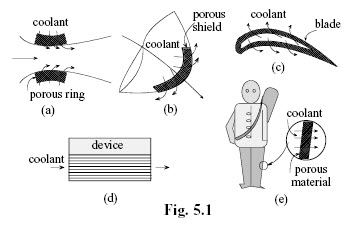
Fig. 5.1 illustrates several examples of conduction in porous media. In Fig. 5.1a, a porous ring is placed at the throat of a rocket nozzle to protect it from high temperature damage. Air or helium is injected through the porous ring to provide an efficient cooling mechanism. Fig. 5.1b shows a porous heat shield designed to protect a space vehicle during atmospheric entry.
Cooling of porous turbine blades is shown in Fig. 5.1c . Transpiration cooling has been proposed as an efficient method for protecting microelectronic components. Fig. 5.1d represents an electronic device with a microchannel sink. Coolant flow through the channels provides effective thermal protection. Fig. 5.1e shows a porous fireman’s suit for use in a hot environment. Other examples include heat transfer in blood-perfused tissue and geothermal applications.
The idea is to provide intimate contact between the coolant and the material to be cooled. Thus heat transfer in porous media is a volumetric process rather than surface action.
Fig. 5.1 illustrates several examples of conduction in porous media. In Fig. 5.1a, a porous ring is placed at the throat of a rocket nozzle to protect it from high temperature damage. Air or helium is injected through the porous ring to provide an efficient cooling mechanism. Fig. 5.1b shows a porous heat shield designed to protect a space vehicle during atmospheric entry.
Cooling of porous turbine blades is shown in Fig. 5.1c . Transpiration cooling has been proposed as an efficient method for protecting microelectronic components. Fig. 5.1d represents an electronic device with a microchannel sink. Coolant flow through the channels provides effective thermal protection. Fig. 5.1e shows a porous fireman’s suit for use in a hot environment. Other examples include heat transfer in blood-perfused tissue and geothermal applications.
Reference: Heat Conduction
Heat Conduction Third Edition by Latif M. Jiji

CONTENTS
CHAPTER 1
BASIC CONCEPTS
CHAPTER 2
ONE-DIMENSIONAL STEADY-STATE CONDUCTION
CHAPTER 3
TWO-DIMESIONAL STEADY STATE CONDUCTION
CHAPTER 4
TRANSIENT CONDUCTION
CHAPTER 5
POROUS MEDIA
CHAPTER 6
CONDUCTION WITH PHASE CHANGE: MOVING BOUNDARY PROBLEMS
CHAPTER 7
NON-LINEAR CONDUCTION
PROBLEMS
CHAPTER 8
APPROXIMATE SOLUTIONS: THE INTEGRAL METHOD
CHAPTER 9
PERTURBATION SOLUTIONS
CHAPTER 10
HEAT TRANSFER IN LIVING TISSUE
CHAPTER 11
MICROSCALE CONDUCTION
Fundamentals of Heat Exchanger Design Ramesh K. Shah and Dusan P. Sekulic
 <
Contents
<
Contents
Chapter 1
Classification of Heat Exchangers
Chapter 2
Overview of Heat Exchanger Design Methodology
Chapter 3
Basic Thermal Design Theory for Recuperators
Chapter 4
Additional Considerations for Thermal Design of Recuperators
Chapter 5
Thermal Design Theory for Regenerators
Chapter 6
Heat Exchanger Pressure Drop Analysis
Chapter 7
Surface Basic Heat Transfer and Flow Friction Characteristics
Chapter 8
Heat Exchanger Surface Geometrical Characteristics
Chapter 9
Heat Exchanger Design Procedures
Chapter 10
Selection of Heat Exchangers and Their Components
Chapter 11
Thermodynamic Modeling and Analysis
Chapter 12
Flow Maldistribution and Header Design
Chapter 13
Fouling and Corrosion
Appendix A: Thermophysical Properties
Appendix B: "-NTU Relationships for Liquid-Coupled Exchangers
Appendix C: Two-Phase Heat Transfer and Pressure Drop Correlations
C.1 Two-Phase Pressure Drop Correlations
C.2 Heat Transfer Correlations for Condensation
C.3 Heat Transfer Correlations for Boiling
Appendix D: U and CUA Values for Various Heat Exchangers
General References on or Related to Heat Exchangers
Thermodynamics and Heat Transfer 2nd edition - Solucionario
by Yunus Cengel

Answers of
Chapter 1
Basics of Heat Transfer
Chapter 2
Heat Conduction Equation
Chapter 3
Steady Heat Conduction
Chapter 4
Trasient Heat Conduction
Chapter 5
Numerical Methods in Heat Conduction
Chapter 6
Fundamentals of Convection
Chapter 7
External Forced Convection
Chapter 8
Internal Forced Convection
Chapter 9
Natural Convection
Chapter 10
Boiling and Condensation
Chapter 11
Fundamentals of Thermal Radiation
Chapter 12
Radiation Heat Transfer
Chapter 13
Heat Exchangers
Chapter 14
Mass Transfer
Chapter 15
Cooling of Electronic Equipment
Termodinámica Yunus A. Cengel (español)

La termodinámica se define como la ciencia de la energía. Aunque todos tenemos idea sobre este concepto, es dificil dar una definición precisa de él. La energía es la capacidad para producir cambios.
La palabra termodinámica proviene de los vocablos griego thermos (calor) y dynamis (potencia), que describe los primeros esfuerzos por convertir el calor en potencia.
Hoy día el mismo concepto abarca todos los aspectos de la energía y sus transformaciones, incluidas la producción de potencia, la refrigeración y las relaciones entre las propiedades de la materia...
La palabra termodinámica proviene de los vocablos griego thermos (calor) y dynamis (potencia), que describe los primeros esfuerzos por convertir el calor en potencia.
Hoy día el mismo concepto abarca todos los aspectos de la energía y sus transformaciones, incluidas la producción de potencia, la refrigeración y las relaciones entre las propiedades de la materia...
Nota: descargar todas las partes para armar el libro completo.
Termograf ver. 5.5 Simulador Termodinámico - Licencia gratuita

 Contraseña | Password
Es un simulador termodinámico con;
- Cálculo de propiedades termodinámicas dibujando los estados, procesos y ciclos directamente sobre el diagrama termodinámico
- Creación de gráficas y diagramas termodinámicos en tiempo real, fácilmente insertables como imágenes en otros documentos
- Configuración de sustancias, unidades, convenio de signos, etc.
- Creación de tablas termodinámicas con análisis gráfico para, por ejemplo, la optimización de un ciclo
- Cálculo de intercambiadores de calor y rendimientos de ciclos
- Balances de energía y entropía, con análisis de trabajos e irreversibilidades
- Editor de ecuaciones para funciones termodinámicas personalizadas con variables de usuario y gráficas personalizadas
- Traducido a 10 idiomas
- Multi-plataforma (Linux, Windows, Macintosh, navegador web, etc).
Facilita la enseñanza de la termodinámica
- Mejor comprensión de los conceptos gracias a su visualización gráfica y a la asistencia en tareas complicadas
- Funciones especiales para la docencia: opciones de video-proyección, configuración de elementos a mostrar (para evitar distractores), etc.
- Corrección automática de ejercicios y análisis de resultados
- Metodología docente propia, basada en la evaluación continua, con una gran colección de ejercicios y recursos didácticos (estas últimas funciones están habilitadas para la versión registrada)
Introducción a la Termodinámica en Ingeniería Química por Smith, Van Ness and Abbott

La ciencia de la termodinámica nació en el siglo XIX como una necesidad de describir el funcionamiento de las máquinas de vapor y de establecer límites a lo que éstas podían hacer. Es así como el nombre mismo significa potencia generada por el calor, y sus aplicaciones iniciales fueron las máquinas térmicas, de las cuales la máquina de vapor es un ejemplo. Sin embargo, los principios observados como válidos para las máquinas pronto se generalizaron en postulados, los cuales se conocen ahora como la primera y segunda leyes de la termodinámica. Estas leyes no tienen demostración en el sentido matemático; su validez se sustenta en la ausencia de experiencia contraria a lo establecido por ellas. Así, la termodinámica forma parte, junto con la mecánica y el electromagnetismo, del conjunto de leyes básicas de la física.
A través de un proceso de deducción matemática, estas leyes conducen a un conjunto de ecuaciones que encuentran aplicación en todas las ramas de la ciencia y la ingeniería. El ingeniero químico debe enfrentar una gama muy amplia de problemas. Entre ellos se encuentra el cálculo de los requerimientos de calor y trabajo para procesos físicos y químicos, así como la determinación de las condiciones de equilibrio para reacciones químicas y para la transferencia de especies químicas entre fases...
Suscribirse a:
Entradas (Atom)
