Bienvenidos en chino
Mobbing-acoso laboral-IRG
Mostrando entradas con la etiqueta Process Simulation. Mostrar todas las entradas

Curso Aspen Hysys Tutorial - Nivel Básico
Curso Aspen Hysys - Avibert

Serie de videos que muestran la aplicación de HYSYS a la teoría de la Termodinámica.

Fuente: Aprende Ingeniería Química

Columnas de Destilación Optimización Económica

Clic en la imagen

Fuente: Misael González Macías

FlexSim 7 Feature Preview Sampler

Click on image

Fuente: FlexsimSoftware

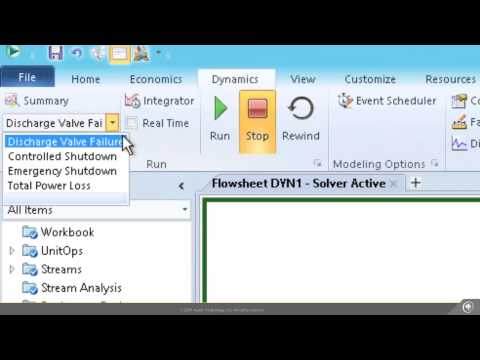
Activated Dynamics for Compressor Surg Aspen HYSYS V8.6

Click on image

Fuente: AspenTechonologyInc

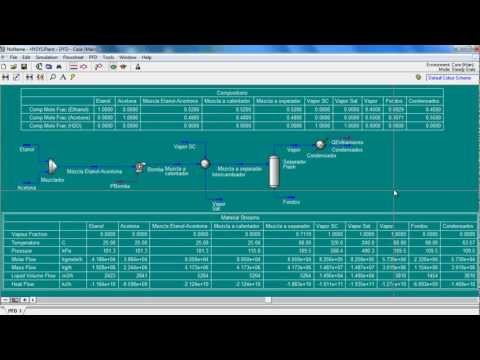
Integración de Mezclador, Bomba e Intercambiador de Calor Etanol-Acetona
Simulación en Hysys

Clic en la imagen

Fuente: Jorge Manuel Cabrera Mateos

Understanding State Machines: What Are They? Will Campbell
Matlab


A finite-state machine (FSM) or finite-state automaton (plural: automata), or simply a state machine, is a mathematical model of computation used to design both computer programs and sequential logic circuits. It is conceived as an abstract machine that can be in one of a finite number of states. The machine is in only one state at a time; the state it is in at any given time is called the current state. It can change from one state to another when initiated by a triggering event or condition; this is called a transition. A particular FSM is defined by a list of its states, and the triggering condition for each transition.

The behavior of state machines can be observed in many devices in modern society which perform a predetermined sequence of actions depending on a sequence of events with which they are presented. Simple examples are vending machines which dispense products when the proper combination of coins is deposited, elevators which drop riders off at upper floors before going down, traffic lights which change sequence when cars are waiting, and combination locks which require the input of combination numbers in the proper order.

Finite-state machines can model a large number of problems, among which are electronic design automation, communication protocol design, language parsing and other engineering applications. In biology and artificial intelligence research, state machines or hierarchies of state machines have been used to describe neurological systems and in linguistics—to describe the grammars of natural languages.

Considered as an abstract model of computation, the finite state machine is weak; it has less computational power than some other models of computation such as the Turing machine. That is, there are tasks which no FSM can do, but some Turing machines can. This is because the FSM has limited memory. The memory is limited by the number of states.

FSMs are studied in the more general field of automata theory.
Understanding State Machines: What Are They? - Avibert


A finite-state machine (FSM) or finite-state automaton (plural: automata), or simply a state machine, is a mathematical model of computation used to design both computer programs and sequential logic circuits. It is conceived as an abstract machine that can be in one of a finite number of states. The machine is in only one state at a time; the state it is in at any given time is called the current state. It can change from one state to another when initiated by a triggering event or condition; this is called a transition. A particular FSM is defined by a list of its states, and the triggering condition for each transition.

The behavior of state machines can be observed in many devices in modern society which perform a predetermined sequence of actions depending on a sequence of events with which they are presented. Simple examples are vending machines which dispense products when the proper combination of coins is deposited, elevators which drop riders off at upper floors before going down, traffic lights which change sequence when cars are waiting, and combination locks which require the input of combination numbers in the proper order.

Finite-state machines can model a large number of problems, among which are electronic design automation, communication protocol design, language parsing and other engineering applications. In biology and artificial intelligence research, state machines or hierarchies of state machines have been used to describe neurological systems and in linguistics—to describe the grammars of natural languages.

Considered as an abstract model of computation, the finite state machine is weak; it has less computational power than some other models of computation such as the Turing machine. That is, there are tasks which no FSM can do, but some Turing machines can. This is because the FSM has limited memory. The memory is limited by the number of states.

FSMs are studied in the more general field of automata theory.


Fuentes: Matlab

Simulation Tips and Tricks Autodesk Inventor

Click on image

Fuente: Autodesk

Introducing APC Model Builder AspenTechnologicInc

Click on image

The new Aspen APC Model Builder uses step test data, historical data and process knowledge to create linear dynamic models for users. All of this helps process manufacturers increase self-sufficiency, improve practitioner efficiency and leverage process knowledge. Robert Golightly, product marketing manager at AspenTech, explains in this demonstration.

Fuente: AspenTechnologicInc

Fundamentals of SolidWorks Simulation SolidWorks

Click on image

SolidWorks Simulation, FEA software for product engineers, helps companies to reduce product development cost, streamline design process and accelerate innovation

Fuente: SolidWorks

Optimizing Manufacturing Production Processes Matlab

Click on image

Use the genetic algorithm from the Global Optimization Toolbox with SimEvents to optimize resources needed for an efficient and effective production process.

Fuente: MATLAB

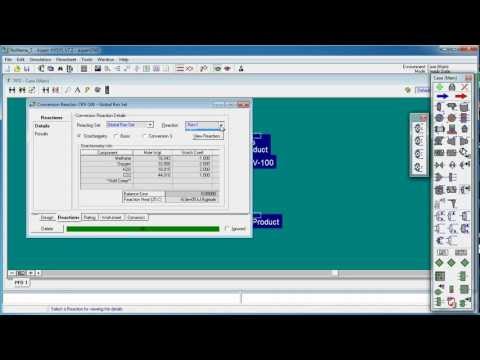
Setting up a Natural Gas Burner Simulation in HYSYS

Click on image

Fuente: Chemical Engineering Resources

Caldera Sencilla Simulación en Hysys 3.2


Plant View in Aspen Plus Tutorial

Click on image

An introduction viewing plant data within the simulation environment in Aspen Plus.

Fuente: AspenTechnologyInc

Evaporador de Multiple Efecto Tutorial de Simulación en Excel

Click on image

Fuente: Balancemasayenergia

Evaporación en Quíntuple Efecto Simulación en Excel

Clic en la imagen


Fuente: Felipe Perafán

COCO Cape Open to Cape Open
Simulation Environment


Fuente: Coco

Fractional Distillation of Crude Oil Simulation on Hysys

Click on image

Torre de Destilación Dinámica Simulación en Hysys

Torre de Destilación Dinámica
Clic en la imagen

Construcción de una Torre de Destilación Dinámica, pero partiendo de un estado estacionario para que en las siguientes partes se pongan los controles lógicos y lo necesario para la simulación dinámica.


Descargar material:

Fuente: GhosTHacK07

Simulación en Aspen Plus Partición de una Torre de Destilación Propano-Propileno


Simulación en Aspen PLUS sobre la partición de una Torre de Destilación para la separación de propano-propileno por destilación de alta presión [Figura 17.5 Henley & Seader 2000], recreada anteriormente en Hysys 7.2.

Ver también: 1 | 2 | 3 | 4 | 5 | 6 | 7 | 8 | 9 | 10 | 11 | 12 | 13 |

Promodel Release 4 Tutorial

Promodel

Ref: Promodel