Bienvenidos en chino
Mobbing-acoso laboral-IRG

Handbook of Industrial Crystallization - 2Ed. Allan S. Myerson

Myerson Cristallization

Table of Contents
1.Solutions and Solution Properties
2.Crystals. Crystal Growth, and Nucleation
3.The Influence of Impurities and Solvents on Crystallization
4.Analysis and Measurement of Crystallization Utilizing the Population Balance
5.Crystallizer Selection and Design
6.Precipitation Processes
7.Melt Crystallization
8.Crystallizer Mixing: Understanding and Modeling Cristallizer Mixing and Suspension Flow
9.Control of Crystallization Processes
10.Batch Crystallization
11.Crystallization in the Pharmaceutical and Bioprocessing Industries
12.Crystallization of Proteins
13.Crystallization in Foods

Descargar
Contraseña: Avibert

Wine Chemistry & Biochemistry
M. Victoria Moreno-Arribas · M. Carmen Polo, Editors

Wine

Table of Contents
Introduction

Part I Chemical and Biochemical Aspects ofWinemaking
1 Biochemistry of Alcoholic Fermentation
2 Biochemical Transformations Produced
3 Special Wines Production
3A Sparkling Wines and Yeast Autolysis
3B Biologically AgedWines
4 Enzymes in Winemaking
5 Use of Enological Additives for Colloid and Tartrate Salt Stabilization in White Wines and for Improvement of Sparkling Wine Foaming Properties
Part II Wine Chemical Compounds and Biochemical Processes
6 Nitrogen Compounds
6A Amino Acids and Biogenic Amines
6B Peptides
6C Proteins
7 Carbohydrates
8 Volatile and Aroma Compounds
8A Wine Aroma Precursors
8B Polyfunctional Thiol Compounds
8C Volatile Compounds and Wine Aging
8D Yeasts andWine Flavour
8E Identification of Impact Odorants of Wines
8F Interactions Between Wine Matrix Macro-Components and Aroma Compounds
9 Phenolic Compounds
9A Anthocyanins and Anthocyanin-Derived Compounds
9B Flavanols, Flavonols and Dihydroflavonols
9C Non-flavonoid Phenolic Compounds
9D Influence of Phenolics on Wine Organoleptic Properties
9E Health-Promoting Effects ofWine Phenolics
Part III Spoilage ofWines
10 Aromatic Spoilage of Wines by Raw Materials and Enological Products
11 Wine Spoilage by Fungal Metabolites
Part IV Automatic Analysers and Data Processing
12 Automatic Analysers in Oenology
13 Statistical Techniques for the Interpretation of Analytical Data
Index

Algebrator 4.0.1 Software

Algebrator

SOFTMATH develops Algebrator, the leading Algebra software program available to, students, teachers, working professionals and educational institutions today.
Algebrator is one of the most powerful algebra software programs ever developed. It will tackle the hardest algebra problems you throw at it. And it can show every step to every answer, effectively serving as an automated tutor for Algebra students at every level.
Students utilize Algebrator to supplement in-classroom learning, as well as assist them with rapidly completing their Algebra assignments.
Teachers use Algebrator to assist in the rapid creation of lessons and sample problems/solutions, as well as a supplemental, automated teaching assistant for students.
Professionals who need to solve Algebra problems use it in their place of work. Whether "math-challenged" or simply looking for productivtiy improvements by solving Algebraic equations quickly and completely, Algebrator is a great "Math Assistant" for the working professional!
Algebrator is a complete Algebra Tutoring solution, appropriate for solving Algebra problems all the way from Pre-Algebra through the Advanced College level.
Try online Demos

Emulsions, Foams and Suspensions Fundamentals and Applications
Laurier L. Schramm

Emulsions, Foams and Suspensions

Table of Contents
1 Introduction
1.1 The Colloidal State
1.2 Classification of Emulsions, Foams, and Suspensions
1.3 Characterization and Stability
2 Dispersion and Dispersed Species Characterization
2.1 Surface Area, Porosity, and Permeability
2.2 Size and Size Distribution
2.3 Conductivity
2.4 Sedimentation, Creaming, and Centrifugation
2.5 Characterization of Emulsions
2.6 Characterization of Foams
2.7 Characterization of Suspensions
3 Interfacial Energetics
3.1 Surface Area
3.2 Surface and Interfacial Tensions
3.3 Pressure and Curved Surfaces
3.4 Contact Angle and Wettability
3.5 Surfactants and Micelles
3.6 Applications of Surface Activity
3.7 Other Lyophilic Colloids: Microemulsions
4 Electrokinetics
4.1 Charged Interfaces
4.2 Electric Double Layer
4.3 Electrokinetic Phenomena
4.4 Electrostatic Properties in Non-aqueous Media
5 Colloid Stability
5.1 Electrostatic and Dispersion Forces
5.2 DLVO Theory and Practice
5.3 Hydration and Steric Effects
5.4 Additional Stabilizing Influences
5.5 Kinetics
5.6 Destabilization of Colloids
6 Colloid Rheology
6.1 Principles
6.2 Measurement
6.3 Non-Newtonian Flow Properties
6.4 Other Viscosity Nomenclature and Parameters
6.5 Dispersion Rheology
6.6 Surface Rheology
6.7 Flow in Pipelines and Constraining Media
7 Preparation, Inhibition, and Destruction of Dispersions
7.1 Preparation
7.2 Destruction and/or Inhibition
8 Introduction to Practical and Industrial Applications
8.1 General Uses
8.2 Emulsions
8.3 Foams
8.4 Suspensions
8.5 Hazards
9 Applications in the Environment
9.1 Introduction
9.2 Rocks, Sediments, and Soils
9.3 Environmental Soil Remediation
9.4 Water and Wastewater Treatment
9.5 Spills and Other Hazards
9.6 Environmental Foam Blankets
10 Mining and Mineral Processing Applications
10.1 Introduction
10.2 Hydraulic Mining and Hydrotransport
10.3 Mineral Flotation
10.3.1 Carrier, Emulsion, and Floc Flotation
10.4 Tailings and Tailings Ponds
10.5 Dust-Suppressing Foam Blankets
11 Petroleum Industry Applications
11.1 Oil Wells and Near Wells
11.2 Reservoirs
11.3 Surface Operations
12 Manufacturing and Materials Science Applications
12.1 Introduction
12.2 Papermaking
12.3 Emulsions for Road Paving
12.4 Metal-working
12.5 Cleaning Processes
12.6 Surface Coatings including Paints and Inks
12.7 Polymer Synthesis
12.8 Ceramics Manufacture
12.9 Fire-Fighting Foams
13 Food Product and Agricultural Applications
13.1 Introduction to Food Colloids
13.2 Stabilizing Agents
13.3 Preparation
13.4 Stability
13.5 Protein-stabilized Emulsions
13.6 Non-protein-stabilized Emulsions
13.7 Foam Food Products
13.8 Other Food Colloids
13.9 Introduction to Agricultural Colloids
14 Biological and Medical Applications
14.1 Introduction
14.2 Vesicle Carriers
14.3 Polymer Coatings
14.4 Emulsion Carriers
14.5 Colloids in Diagnostics
15 Personal Care Product Applications
15.1 Introduction
15.2 Detergents, Shampoos and Conditioners
15.3 Cosmetic Skin Care Products
15.4 Other Personal Care Products
16 Emerging Areas in Emulsions, Foams and Suspensions
16.1 Smart Colloids
16.2 Nanodispersions
16.3 Combatting Terror Agents
17 Glossary of Emulsion, Foam and Suspension Terminology
17.1 Introduction
17.2 Terms
18 References
Index


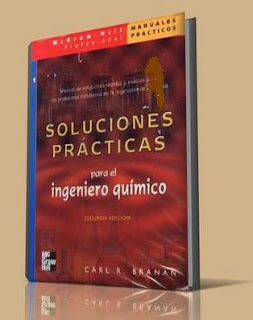
Manual de Soluciones Prácticas
para el Ingeniero Químico Carl R. Branan

Soluciones Prácticas para el Ingeniero Químico

Tabla de Contenidos
Sección Uno

Diseño del equipo
1. Flujo de fluídos
2. Intercambiadores de calor
3. Fraccionadoras
4. Absorbedoras
5. Bombaas
6. Compresoras
7. Elementos motores
8. Separadores-Acumuladores
9. Calderas
10 Torres de enfriamiento
Sección Dos
Diseño de Procesos
11. Refrigeración
12. Tratamiento de gases
13. Sistemas de vacío
14. Transportación neumática
15. Mezclado
Sección Tres
Diseño de la Planta
16. Evaluación de Procesos
17. Contabilidad
18. Metalurgia
19. Seguridad
20. Controles
Sección Cuatro
Operaciones
21. Detección de Fallas
22. Arranque
23. Conservación de la energía
24. Modelado de procesos aplicando la programación lineal
25. Propiedades
Apéndices